Why AI Is Transforming Power Infrastructure

Executive Introduction
For the past two decades, infrastructure planning has largely followed predictable patterns. Load growth was gradual, driven by population, industrial expansion, and incremental digitization. Power engineers, utilities, and data center operators could forecast demand years in advance with reasonable confidence.
That predictability is ending.
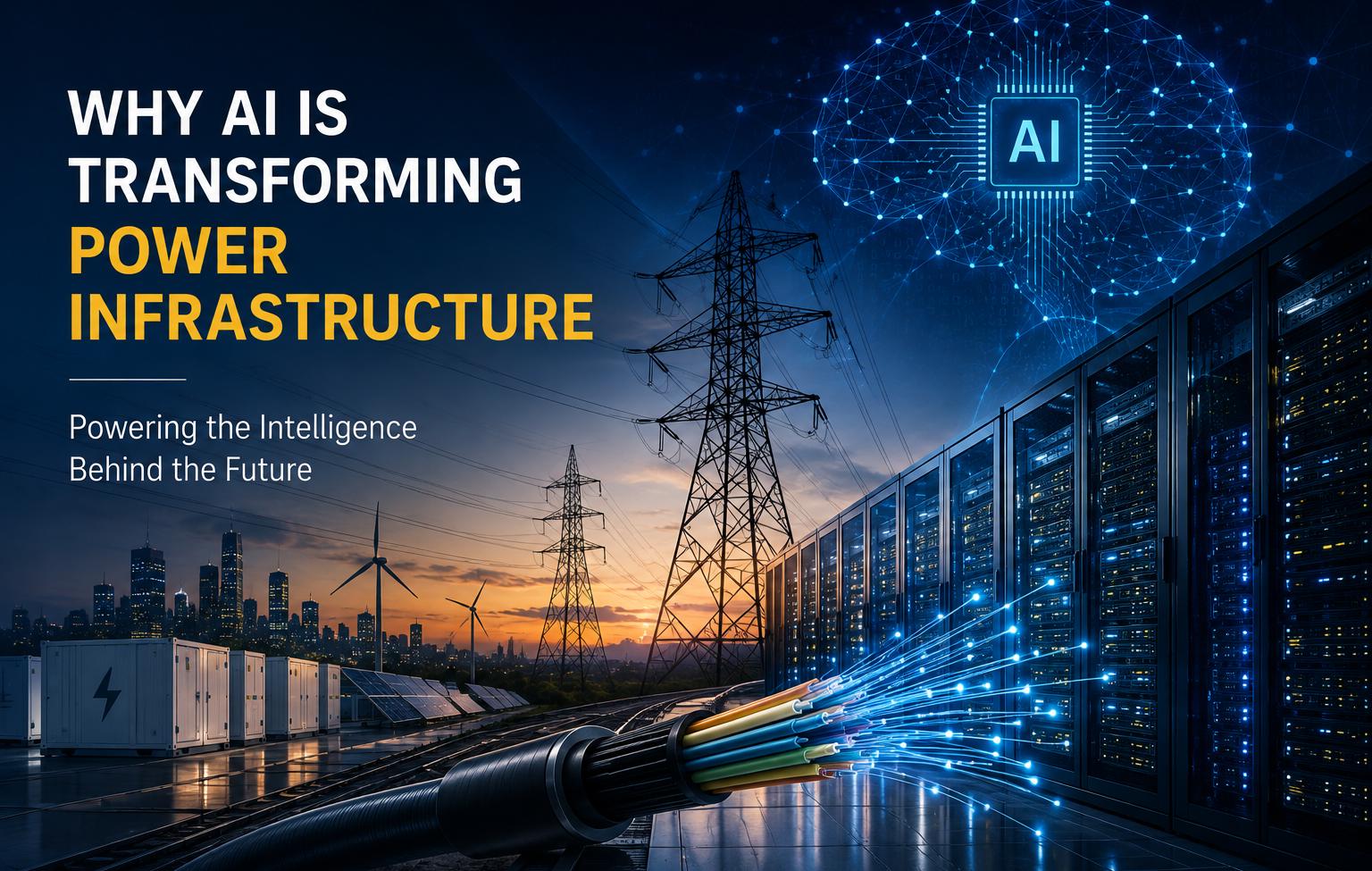
The rapid scaling of artificial intelligence workloads is introducing a new category of demand—one that is concentrated, capital-intensive, and growing faster than the infrastructure designed to support it. This is not simply a computing trend. It is an infrastructure trend, and its center of gravity is power.
This article examines why AI is reshaping power infrastructure, where the pressure points are emerging, and what this means for engineers, operators, and decision-makers across the energy and digital infrastructure value chain.
Why AI Changes Infrastructure—Not Only Computing
AI is often discussed as a software or compute story: model size, training runs, GPU generations. But every layer of that stack ultimately converges on a physical constraint—electricity.
Training and running large AI models requires sustained, high-density power delivery at a scale that traditional data center design did not anticipate. A single AI training cluster can now consume as much power as a mid-sized industrial facility, and hyperscale AI campuses are being planned with power demands measured in hundreds of megawatts.
This shifts the conversation. AI is no longer just a data center topic—it is a grid topic, a substation topic, and in many regions, a generation-planning topic. Utilities that once negotiated interconnection agreements over years are now fielding requests for gigawatt-scale capacity on compressed timelines.
The result is that power infrastructure, not compute architecture, is increasingly the limiting factor in how quickly AI capacity can be deployed.
Why Power Is Becoming the Primary Bottleneck
Three structural factors are converging:
- Speed of demand growth. AI capacity buildout is happening in months and quarters, while transmission and generation projects typically require years of planning, permitting, and construction.
- Density of load. AI compute clusters concentrate enormous power draw into small physical footprints, straining local distribution networks that were not designed for this density.
- Volatility of load profiles. Training workloads can create rapid power fluctuations—sudden ramps and drops—that differ from the steadier consumption patterns utilities are accustomed to managing.
Grid operators are now managing a demand curve that looks fundamentally different from historical models, and much of the existing infrastructure—transformers, switchgear, transmission corridors—was engineered for a different era of load behavior.
Impact Across the Infrastructure Stack
Grid Infrastructure
Interconnection queues in many markets are already backlogged, with new large loads waiting years for grid capacity studies and upgrades. Utilities are being asked to plan not for steady growth, but for step-function increases tied to single customer decisions.
Electrical Distribution
Substations and distribution networks near AI campuses require significant reinforcement. Utilities are increasingly evaluating dedicated feeders, on-site generation, and behind-the-meter arrangements to bypass constrained transmission paths.
Critical Power
Redundancy models built around N+1 or 2N configurations must now account for far larger unit sizes. Critical power architecture is being re-engineered around higher voltage distribution within the data hall itself, reducing conversion losses at scale.
UPS Systems
Traditional UPS topologies face new demands from AI’s fast, high-amplitude load swings. Static and rotary UPS systems are being evaluated not only for backup duration, but for their ability to respond to sub-second power transients generated by GPU cluster synchronization.
Battery Energy Storage Systems (BESS)
BESS is emerging as a dual-purpose asset: providing ride-through power protection while also smoothing the volatile load profiles that AI training introduces to the grid. This is a shift from BESS as a backup asset to BESS as an active grid-interaction tool.
Renewable Integration
Renewable generation paired with storage offers a path to faster capacity additions than new thermal or nuclear generation, but intermittency remains a challenge for workloads that require continuous, high-reliability power. Hybrid renewable-plus-storage-plus-firm-generation models are becoming more common in AI infrastructure planning.
Data Center Design
Rack densities that once averaged 5–10 kW are now reaching 40–100+ kW for AI clusters. This is driving a shift toward liquid cooling, higher-voltage DC distribution, and facility designs where power delivery—not floor space—is the primary constraint on capacity.
Fiber and Digital Infrastructure
AI workloads distributed across multiple facilities depend on low-latency, high-bandwidth interconnection. This is accelerating demand for dense fiber routes between data center campuses and reinforcing the importance of resilient, diverse fiber paths as a companion requirement to power availability.
Engineering Challenges Over the Next Decade
Several challenges will shape infrastructure engineering priorities:
- Timeline compression. Aligning multi-year utility planning cycles with AI deployment schedules measured in quarters.
- Standardization gaps. Developing design standards for power quality, protection coordination, and redundancy that reflect AI’s load characteristics rather than legacy IT load assumptions.
- Workforce capacity. Expanding the pool of engineers qualified in high-voltage distribution, BESS integration, and critical power design at the rate infrastructure demand requires.
- Siting and permitting. Balancing the urgency of capacity delivery with environmental review, community engagement, and grid stability requirements.
- Interoperability. Ensuring that on-site generation, storage, and grid supply can be coordinated safely and efficiently as hybrid power architectures become standard.
None of these are new problems in isolation. What is new is the scale and speed at which they must now be solved simultaneously.
Opportunities for Utilities, Infrastructure Owners, and Governments
This period of strain also presents structural opportunities:
- Utilities have a rare opportunity to modernize grid infrastructure with private capital co-investment from large loads seeking capacity certainty.
- Infrastructure owners and developers who invest early in flexible, modular power architecture will be better positioned as demand patterns continue to evolve.
- Governments and regulators have an opening to update interconnection frameworks, streamline permitting for storage and transmission, and incentivize grid-supportive designs such as demand flexibility and on-site storage.
- Equipment manufacturers are being pushed toward faster innovation cycles in switchgear, transformers, and power electronics suited to AI-scale, high-density, high-volatility loads.
Handled well, this period could accelerate grid modernization efforts that were already necessary for reasons beyond AI, including renewable integration and aging infrastructure replacement.
A Professional Perspective
Having worked across telecommunications, power, and critical infrastructure environments, I have observed firsthand how quickly assumptions about “normal” load and capacity planning can become outdated when a new class of demand enters the picture. AI is not the first technology to strain infrastructure planning cycles, but the scale and speed involved this time are notable.
What stands out to me is that the answers are not purely technical. They require closer coordination between utilities, infrastructure developers, and regulators than has historically been necessary. Engineers can design more resilient, flexible power systems, but the pace of deployment will ultimately depend on how well planning, permitting, and investment processes adapt alongside the technology itself.
Conclusion
AI’s impact on infrastructure is often framed in terms of chips and models, but the more consequential story is unfolding in substations, distribution networks, and power architecture decisions being made today. The organizations that treat power infrastructure as a strategic priority—rather than an afterthought to compute planning—will be better positioned for what comes next.
This is a conversation that benefits from many perspectives: engineers, utility planners, data center operators, and policymakers all have a role to play.
I would welcome hearing how others in this field are seeing these pressures play out in their own markets and projects.
